
The Retrofit Roadmap is a guide for navigating the barriers and complexities that make retrofitting existing buildings so expensive and rare. Planning a retrofit starts with the end in mind – a near net-zero building – and steers clear of blind alleys like partial solutions that block so many attempts to get to net zero.
Who is the roadmap for?
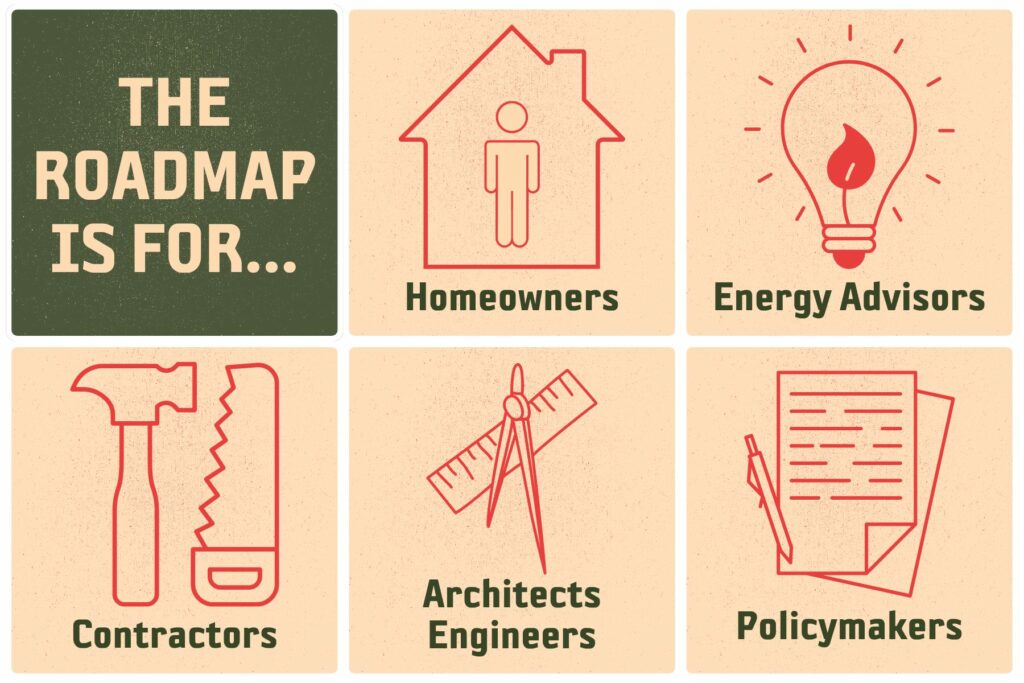
This roadmap is a comprehensive guide for anyone involved in deep retrofits. It offers practical insights and strategies to navigate the retrofit process efficiently and cost-effectively. Whether you’re a homeowner, building owner, energy advisor, contractor, architect, or policymaker, this roadmap will provide valuable guidance.
Homeowners and Building Owners: Learn how to avoid common pitfalls and achieve significant energy savings.
Energy Advisors and Retrofit Coaches: Use the roadmap to guide clients through the retrofit process.
Contractors: Gain knowledge on cost-effective retrofit techniques and minimize disruptions.
Architects and Engineering Consultants: Design retrofit projects that avoid piecemeal upgrades and achieve long-term energy efficiency.
Policymakers: Understand the most effective path to net-zero residential buildings and develop targeted programs and incentives.
Avoid piecemeal retrofits
Piecemeal retrofits are individual energy upgrades done without much of a plan. While piecemeal retrofits do reduce ongoing emissions somewhat, they can – and usually do – lock in the remaining emissions indefinitely. How do piecemeal retrofits waste money and lock in the remaining emissions, and prevent you from getting to net-zero?

Some examples might help:
- Adding attic insulation without addressing airtightness. Air leakage into attics is often a huge source of heat loss. The leaking air also drives down humidity and can cause rot when it condenses in the attic. This is even more difficult and expensive to fix once you’ve added more insulation.
- Siding replacements that include adding a little more insulation but not enough to get to near-net-zero territory and/or not making the wall airtight when it’s easy. The big cost is the siding replacement itself. The cost of the extra insulation and the airtightness for net-zero-ready is minor.
- Replacing windows with ones that are better but not as good as they should be for net-zero-ready. For a small extra cost, they could have been right for net-zero-ready, preventing condensation and providing way better comfort levels in hot or cold weather.
- Not thinking about how wall insulation/siding replacement upgrades will synchronize with window replacements.
- Adding solar before making sure that it won’t get in the way of getting the attic/roof insulation you need. Sometimes, increasing the roof thickness is the best way to add insulation and stop air leaks into the attic.
Piecemeal upgrades like these are wasteful. They waste homeowners’ hard-earned money, not to mention taxpayer subsidy dollars. Deep retrofit experts frequently encounter examples like those above in tough conversations with frustrated owners agonizing over whether to spend even more money to redo previous upgrades. Those upgrades were done with the best intentions – and frequently based on advice and incentives from their municipal, provincial, or federal governments. Even NRCan’s Renovation Upgrade Report accompanying every EnerGuide audit emphasizes individual measures without pointing out the advantages of combining them. This leads to piecemeal upgrades that can prevent that building from ever getting close to net-zero.
The low-hanging fruit habit that leads to piecemeal retrofits is hard to break. This is how we’ve been going about energy upgrades since the 1970s oil crisis, when the goal was simply saving energy.
This short-sighted focus on easy wins also impacts larger buildings, with entire teams of building professionals overlooking the fact that upgrade or repair projects often represent the only realistic opportunity to achieve net-zero readiness. Regardless of the type or size of the building, piecemeal retrofits fail to capitalize on maintenance and building upgrades as a pathway to making the building future-ready.
The goals have changed. In the 1970s, we were trying to reduce the use of fossil fuels because they were getting expensive. Now, we are trying to replace them altogether because that’s what we need for a stable planet. This new goal of zero takes a new way of thinking and careful planning.
Finally, the piecemeal approach often misses out on many other advantages of deep retrofits: healthier indoor air all year round, luxurious comfort, ultra-low energy bills, improved airtightness, reduced energy demands, and increased comfort.
It doesn’t have to be this way. The best way to avoid this needless waste of time and resources is to start energy and emissions upgrades with a comprehensive plan to get the building to net-zero.



